
Sticker shock at the pharmacy is more than frustrating. It can push people to skip doses, stretch medication, or abandon a prescription altogether. If that is you, please know this: there are legitimate, repeatable ways to lower what you pay, and you do not have to figure it out alone.
Below is the same step-by-step approach I walk patients through at the clinic. You can do it in one afternoon, and you can repeat it whenever a medication changes.

Step 1: Gather the details that control your price
Before you start comparing options, pull together the specifics. Small differences can change the price dramatically.
- Medication name (brand and generic if you know it)
- Strength (example: 10 mg)
- Dose and frequency (example: 1 tablet daily)
- Quantity (30-day supply vs 90-day supply)
- Form (tablet, capsule, liquid, inhaler, cream)
- Your insurance info (RxBIN, RxPCN, RxGroup, member ID) and whether you have a deductible
If you are comfortable, also note what you paid last time and whether you used insurance, a coupon, or cash. That helps you quickly spot what is driving the cost.
Step 2: Ask the pharmacy to quote prices three ways
This is one of the simplest and most overlooked tactics. Ask your pharmacy to tell you the price in each scenario:
- Using your insurance (an insurance-adjudicated claim)
- Cash price (no insurance claim)
- Cash price with a discount card (if you have a specific card or coupon you want them to try)
Why it matters: sometimes insurance is best, sometimes cash is best, and sometimes a coupon beats both. Also, if you have a high deductible, your “insurance price” can look like full price until the deductible is met.
What to say: “Can you please tell me what this costs with my insurance, what the cash price is, and what it is with this discount card?”

Step 3: Compare pharmacies and online options
I am loyal to my local pharmacy too. But prices can vary widely between:
- Big chain pharmacies
- Grocery store pharmacies
- Warehouse club pharmacies (often open to non-members for the pharmacy, but check your state rules and that retailer’s policy)
- Independent community pharmacies
- Mail-order pharmacies
- Cash-only online pharmacies that sell medications directly (often good for generics). These platforms typically bypass insurance and may be cheaper than a local cash price for some drugs.
Also check whether a pharmacy is preferred or out of network for your plan. Two pharmacies across the street from each other can have very different copays if one is “preferred.”
When you price shop, keep the quantity the same. A 90-day supply is often cheaper per dose than a 30-day supply, especially for stable, long-term medications.
Tip: If a pharmacy quotes a much lower price, ask your current pharmacy if they can match it. Some can, some cannot, but it never hurts to ask.
One practical note: If you switch pharmacies, you can usually request a prescription transfer. Controlled substances and certain state rules may add extra steps, so ask the pharmacist what to expect.
Step 4: Use discount cards wisely
Discount cards can be very helpful, especially for generic medications and when you are uninsured or underinsured. They work by negotiating a discounted cash price at participating pharmacies.
How to use them without surprises
- You generally must choose one price path per fill. Most of the time, you use either an insurance-adjudicated price or a cash or discount-card price. You typically cannot combine a discount card with insurance for the same fill.
- Check your deductible impact. Paying with a coupon usually does not count toward your insurance deductible or out-of-pocket maximum when the claim is not submitted to insurance.
- Ask about quantity limits. Some coupon prices change with a 30-day vs 90-day supply.
- Protect your privacy. Read the app or card privacy policy if you are sharing personal information.
If you are unsure, your pharmacist can often tell you whether the coupon is likely to help for that specific medication and dose. If Step 2 shows a discount card is best, use this section to avoid surprises.
Step 5: Talk to your prescriber about lower-cost options
As a clinician, I can tell you that we want to know when cost is a barrier. We can only help if we know what is happening at the pharmacy counter.
Requests that often lower cost
- Ask for a generic if you were prescribed a brand-name medication.
- Ask about a therapeutic alternative in the same drug class that may be cheaper on your plan.
- Ask if you can switch to a different formulation (example: tablet instead of dissolvable tablet, vial instead of auto-injector, different inhaler device) if clinically appropriate.
- Ask for a 90-day prescription for maintenance meds.
- Ask if pill splitting is safe for your specific medication and dose. This is not appropriate for many meds, especially extended-release or enteric-coated tablets.
What to say: “This medication is costing me more than I can afford. Are there generics or similar options that work the same way but cost less? If you think it is safe, could we also consider a 90-day supply?”
Important: Do not change how you take a medication on your own to save money. Some changes can be dangerous or make the medication ineffective.
Step 6: Ask about manufacturer copay cards
If you have commercial insurance (not government insurance), some brand-name medications offer copay cards that lower what you pay at the pharmacy. These programs vary a lot.
- Best for: people with private insurance facing high copays for a brand-name drug
- Usually not allowed with: Medicare, Medicaid, and other government-funded coverage. Many programs also exclude Tricare, VA coverage, and other specific plans. Read the terms.
- How they work: many require your commercial insurance to be run first, then the copay card reduces the remaining amount (it is not the same as a cash coupon).
- Where to find them: the medication’s official manufacturer website or by asking your doctor’s office if they have the enrollment link
Copay cards can be a bridge, but they are not always a long-term solution. If you rely on one, ask what happens when the offer ends.
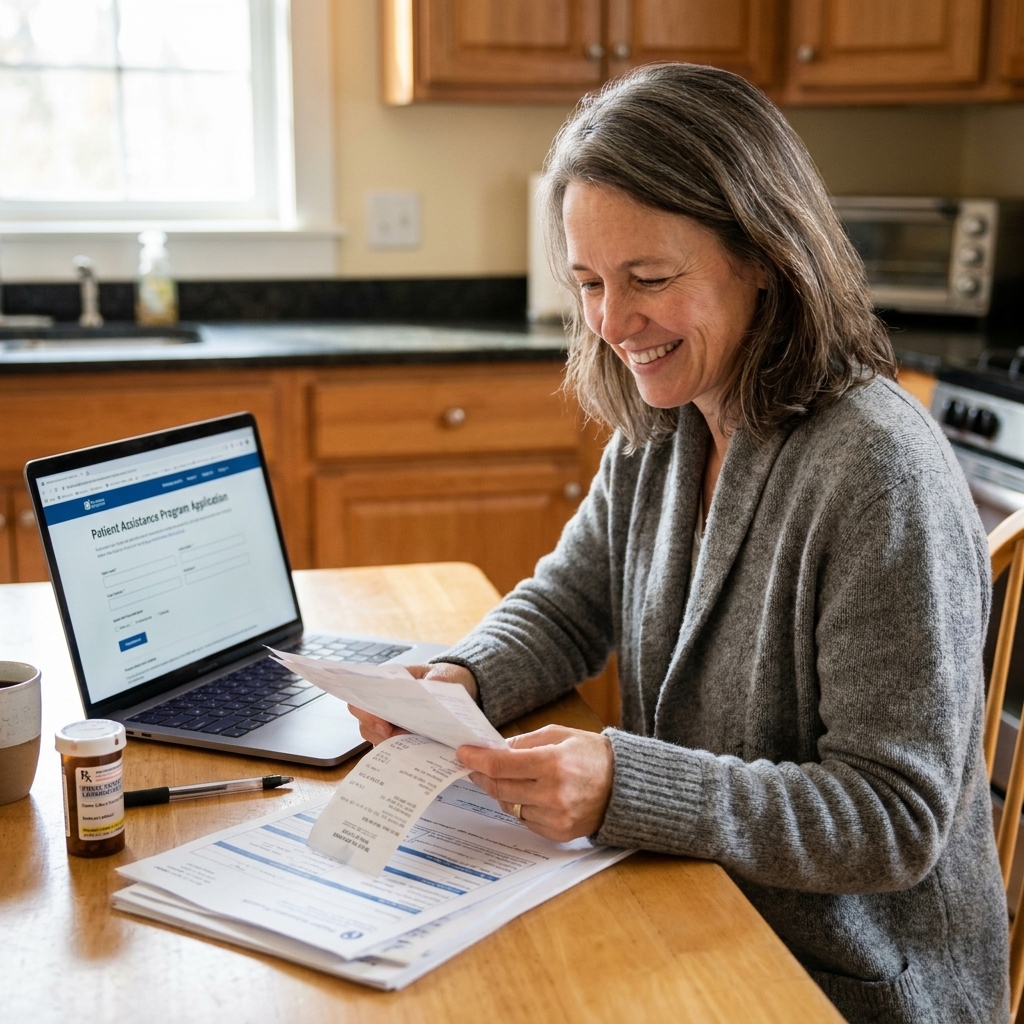
Step 7: Apply for patient assistance programs
Patient assistance programs are often the biggest cost-saver for people who qualify. Many are run by drug manufacturers or nonprofit foundations and may provide medication at low cost or no cost.
A quick heads up: eligibility rules vary widely. Some programs exclude people with any insurance, while others focus on certain coverage situations or income thresholds. If you get told “no” once, it can be worth checking a different program or foundation.
What you typically need
- Proof of income (pay stubs, tax return, or benefits letter)
- Insurance information or proof of being uninsured
- A signed form from you and your prescriber
If paperwork feels overwhelming, ask your clinic if they have a care coordinator, social worker, or pharmacy assistance team. In many practices, someone can help you complete and submit forms.
Step 8: Use your formulary and plan tools
Your plan’s formulary is the list of medications it prefers and covers at different cost levels, often called tiers. Two medications that treat the same condition may land on very different tiers.
If your insurer has an app or cost estimator tool, use it. Many plans will show a price range by pharmacy, along with preferred options.
What to look for
- Tier level (lower tier usually means lower cost)
- Preferred pharmacy status (this can change your copay a lot)
- Prior authorization requirements
- Step therapy (you may need to try a lower-cost option first)
- Quantity limits
If you are stuck in a prior authorization loop, ask your prescriber’s office what they need from you, and ask your insurer exactly what criteria must be met. Clarity shortens delays.
Step 9: Consider 90-day and mail order
For long-term meds that are working well, mail order or 90-day fills can reduce copays and cut down on missed doses, depending on your plan. This is especially helpful for blood pressure medications, cholesterol medications, thyroid hormone, many antidepressants, and other maintenance therapies.
Some plans require a preferred mail-order pharmacy for the best price. Others price 90 days differently than you would expect. It is worth checking before you commit.
Not every medication is a good fit for mail order. If a drug needs to be started and adjusted quickly, or if it is temperature-sensitive, talk it through with your pharmacist first.
Quick example: I have seen patients cut their monthly cost dramatically by switching a stable generic from a 30-day local fill to a 90-day preferred pharmacy or cash-only online option. It does not work for every plan or every drug, but it is one of the highest-yield checks.
Step 10: Backup options if you are still stuck
Appeal an insurance decision
If your plan denies coverage or places a medication on a high tier, you can sometimes appeal with supporting documentation from your prescriber.
Check nonprofit foundation help
Some foundations provide grants to help with copays for certain diagnoses. Availability comes and goes, so it can be worth checking more than once.
Use a legitimate pharmacy
Please be cautious with online “pharmacies” advertising extreme discounts. If it sounds too good to be true, it often is. If you are considering an online option, ask your pharmacist to help you verify it is properly licensed and safe.
If you do not have a regular clinician
If you are between doctors or uninsured, consider community health centers, local public health clinics, or dialing 211 in the U.S. to ask about local medication assistance and low-cost care options.
Medication-saving checklist
- I know my medication name, dose, and quantity.
- I asked the pharmacy to quote insurance, cash, and discount-card prices.
- I checked whether my pharmacy is preferred on my plan.
- I compared at least two pharmacies, including an online cash-only option if it fits.
- I asked my prescriber about a generic or lower-cost alternative.
- I asked about 90-day fills when appropriate.
- I checked for manufacturer copay cards (brand meds) and patient assistance programs (if eligible).
- I reviewed my formulary tier and any prior authorization, step therapy, or quantity limit rules.
When to call your doctor right away
If you cannot afford a medication, do not quietly stop it. Reach out. We can often adjust the plan safely.
- Call urgently if the medication is for heart conditions, blood pressure, blood thinners, diabetes (including insulin), seizures, severe asthma or COPD, transplant medications, adrenal steroids, or time-sensitive treatments like antibiotics for an active infection.
- Call soon for antidepressants, anxiety medications, thyroid medication, and other daily maintenance medications so you do not run out or stop abruptly.
If you are unsure how urgent it is, call and ask. If you are ever in danger because you cannot access essential medication, seek immediate help locally.
FAQ
Is it legal to use a prescription discount card?
Yes, discount cards are legal. They typically function as a negotiated cash price. The main catch is that you usually must choose either an insurance-adjudicated price or a cash or discount-card price for the same fill, and the purchase may not count toward your deductible if insurance is not billed.
Why is the same medication cheaper at a different pharmacy?
Pharmacies purchase medications at different prices and have different contracts with pharmacy benefit managers, insurers, and discount-card networks. Your final price is a mix of drug cost, contracts, and your plan rules, including whether the pharmacy is preferred or out of network.
Can I ask my doctor to change my prescription just because of cost?
Absolutely. Cost is a medical adherence issue. A medication that is unaffordable is not a workable treatment plan, and prescribers are used to adjusting based on coverage and budget.
Should I buy medications from another country?
This is a nuanced topic that depends on where you live and the medication. Safety and legality vary. Before you do anything, talk with your pharmacist or clinician to avoid counterfeit products and dangerous substitutions.
A final note from me: I grew up in a place where people delayed care because money was tight and the system felt hard to navigate. If you are feeling embarrassed or overwhelmed, please let that go. Bring the problem into the open with your pharmacist and prescriber. Saving money on prescriptions is often a team effort, and you deserve a plan you can actually follow.